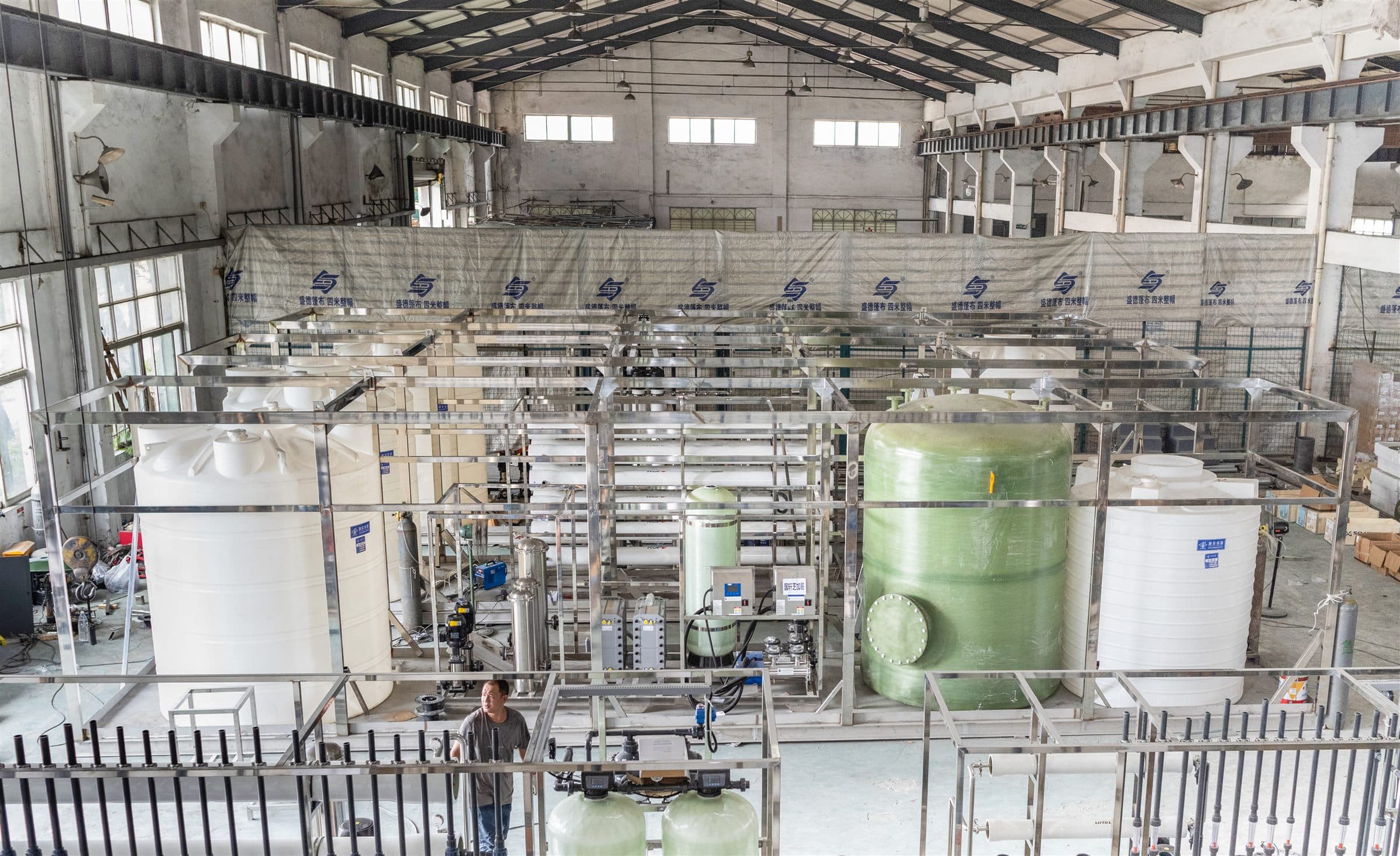
Choose the treatment route from the required point-of-use water quality and the real feed-water analysis—not from a generic machine name. Single-pass RO is often an efficient starting point; double-pass RO adds a second desalting barrier; RO + EDI is used when a stable, low-conductivity polishing stage is required.
The short answer for procurement teams
Industrial RO, double-pass RO and RO + EDI are not interchangeable labels. They describe different process routes with different assumptions about feed water, product-water quality, operating stability and downstream risk. A practical choice begins with the process that will consume the water: boiler make-up, rinsing, chemical preparation, laboratory supply, electronics cleaning or another defined use.
A single-pass RO system removes a large share of dissolved salts and many other dissolved constituents when its membranes, recovery and pretreatment match the feed water. Double-pass RO sends the first-pass permeate through a second RO stage to reduce remaining ions further. RO + EDI adds electrodeionization after RO, continuously polishing suitable RO permeate without the chemical regeneration associated with conventional mixed-bed ion exchange.
The route with the lowest purchase price is not automatically the lowest project risk. If the water is used in a sensitive rinse or production step, the cost of unstable quality, extra cleaning, rejected product or an unplanned modification may be more important than the initial difference between process routes.
- Start with a recent representative feed-water analysis.
- Define quality at the point of use, not only at the skid outlet.
- Confirm hourly peak demand, daily volume and storage/distribution requirements.
- Ask how the proposed configuration will be tested before shipment and verified after installation.
What single-pass industrial RO is designed to do
A conventional industrial RO train normally includes feed conditioning, cartridge filtration, high-pressure pumping, membrane vessels, instrumentation and a cleaning strategy. Pretreatment may include multimedia filtration, activated carbon, softening, chemical dosing, ultrafiltration or other steps, depending on turbidity, hardness, oxidants, silica, organics, biological loading and seasonal variation.
Single-pass RO is often considered where the application can accept RO permeate quality and where the incoming water is controlled well enough to support stable membrane operation. It can be a good fit for many process-water duties, first-stage demineralization, rinse-water applications and as the upstream stage for a polishing process. The final choice must still account for ionic composition, not only TDS: a modest total value can still include scaling or difficult-to-remove species.
During technical review, a supplier should state the assumed feed-water temperature, recovery, flux, feed pressure and membrane selection. These assumptions influence permeate flow and salt passage. Comparing proposals without these design conditions can be misleading, because a nominal capacity alone does not explain what water quality or membrane life is expected.
- Ask for the proposed recovery and its basis.
- Review antiscalant, softening and cleaning assumptions.
- Request conductivity, flow, pressure and sampling points on the P&ID.
- Clarify whether the quoted flow is continuous, average or peak delivery.
| Route | Typical role | Engineering review focus |
|---|---|---|
| Single-pass RO | Primary desalination | Feed chemistry, recovery and final use |
| Double-pass RO | Additional ionic reduction | Product-water target and operating margin |
| RO + EDI | Continuous high-purity polishing | RO permeate suitability and quality control |
Send the feed-water analysis, target quality, required capacity and operating profile. We will help structure the next engineering questions.
Send your project inputsWhen double-pass RO becomes the more defensible route
In double-pass RO, the second stage treats the permeate from the first stage. Because its feed is already lower in dissolved solids, the second pass can reduce residual ionic content and provide an additional buffer against normal feed-water variation. Interstage pH adjustment or carbon dioxide management may be considered where carbonate chemistry affects the result; the correct approach depends on the analysis and target quality.
The extra pass also adds pumps, membranes, controls, electrical load, maintenance points and a more detailed startup procedure. It should therefore solve a real quality requirement rather than be selected only because it sounds more advanced. A useful question is: what is the maximum acceptable conductivity, silica, hardness, sodium, chloride or other relevant constituent at the process point, and how will that limit be monitored?
For buyers, the value of a second pass is often operational margin. It can reduce the pressure on downstream polishing equipment and make the system better able to handle small changes in first-pass performance. It is not a substitute for poor pretreatment, weak sampling discipline or an incomplete water analysis.
- Use a second pass when the water-quality target requires more margin than single-pass RO can reliably provide.
- Specify whether the second pass is fed by first-pass permeate only and how interstage treatment is controlled.
- Evaluate reject handling, flushing, interlocks and conductivity alarms as part of the route—not as optional extras.
Where RO + EDI fits
RO + EDI is a high-purity water route in which EDI receives appropriately conditioned RO permeate. The EDI module uses ion-exchange media, ion-selective membranes and electrical potential to remove remaining ions continuously. It is commonly considered for industrial applications that need consistently low conductivity and want to avoid routine acid and caustic regeneration associated with a conventional mixed-bed polishing system.
EDI is not a universal final-polishing solution. It requires feed conditions within the equipment supplier's limits, particularly for hardness, carbon dioxide, oxidants and other constituents that can affect performance. The upstream RO must therefore be designed as part of the EDI system, not purchased as an isolated machine. A proposal should identify required pretreatment, EDI feed-quality conditions, monitoring points and the actions to take if those limits are not met.
For sensitive production water, buyers should also consider the distribution loop, storage tank venting, recirculation, sanitization approach and point-of-use materials. A low conductivity value measured at the skid is only one part of a usable water-quality specification.
- Request the EDI feed specification and the expected product-water monitoring range.
- Include upstream conductivity, pressure and flow interlocks in the control narrative.
- Define the responsibility boundary between generation, storage, distribution and point-of-use quality.
A decision framework that avoids over-specification
The most reliable comparison uses a requirement matrix. In one column, list the feed-water data and its confidence. In another, list the product-water limits and the consequence of nonconformance. Then compare each route against capacity, operating hours, redundancy, chemical use, utilities, footprint, reject routing, maintenance capability and expansion plans.
This method often reveals that the correct answer is a staged system. For example, a site may install pretreatment and RO for the first phase while reserving tie-in space and controls for double-pass RO or EDI if a future production line needs tighter quality. Conversely, an application with a firm high-purity requirement should not depend on a vague future upgrade; the necessary polishing route should be defined before procurement.
Avoid claims such as ‘zero TDS’ or ‘ultrapure’ unless a written specification defines the relevant limits, sampling method and point of measurement. Engineering documents should identify what is guaranteed, what is a design estimate and what requires final confirmation after the feed-water analysis and site survey.
- Use a written water-quality specification with units and sampling points.
- Separate guaranteed parameters from indicative design values.
- Document utility availability, drainage and space before freeze of layout.
- Plan for representative commissioning samples after installation.
Factory testing, shipment inspection and startup readiness
A factory acceptance test is most useful when it follows an agreed checklist rather than a casual visual inspection. Typical checks include instrument identification, pressure testing where applicable, panel function, pump rotation, alarms, flow indication, interlocks, piping cleanliness and an operating run with available test water. The test cannot reproduce every site condition, especially when the actual feed water is unavailable, so the report should state those limitations clearly.
Before shipment, verify equipment tags, spare parts, preservation requirements, packing list, lifting points, electrical documents, P&ID revision and any outstanding punch-list items. For overseas projects, an installation-preparation package should describe incoming utilities, drain requirements, foundation or skid support, pipe connection sizes, cable requirements and recommended consumables. This reduces avoidable delay when the equipment reaches site.
At commissioning, record initial feed conditions, operating pressures, flows and product-water quality. These baseline records are more valuable than a single ‘pass/fail’ statement because they allow later performance normalization and troubleshooting.
- Agree FAT acceptance criteria before fabrication is complete.
- Keep a shipment-inspection record linked to the approved equipment list.
- Prepare commissioning forms for baseline operating data and water samples.
Questions buyers commonly ask
Is double-pass RO always better than single-pass RO?+
No. It is better only when the required water quality and operating margin justify the extra equipment and utilities. The feed-water analysis and point-of-use specification should decide.
Can EDI treat raw water directly?+
No. EDI is normally fed with properly conditioned RO permeate. Its feed-quality limits must be reviewed during design.
What should a buyer send for a first proposal?+
A recent water analysis, required quality, peak and daily demand, application, operating hours, location, utilities and project schedule are the best starting inputs.
What quality should be guaranteed?+
Only parameters, sampling locations and operating conditions that are written into the approved technical agreement should be treated as guaranteed.
Turn the guide into a project brief.
Final process selection and performance commitments should follow the complete feed-water analysis, application requirements, site utilities and approved technical agreement.